
Foundation & Structural Repairin Greenville, SC
The Part We Can't Stop Thinking About
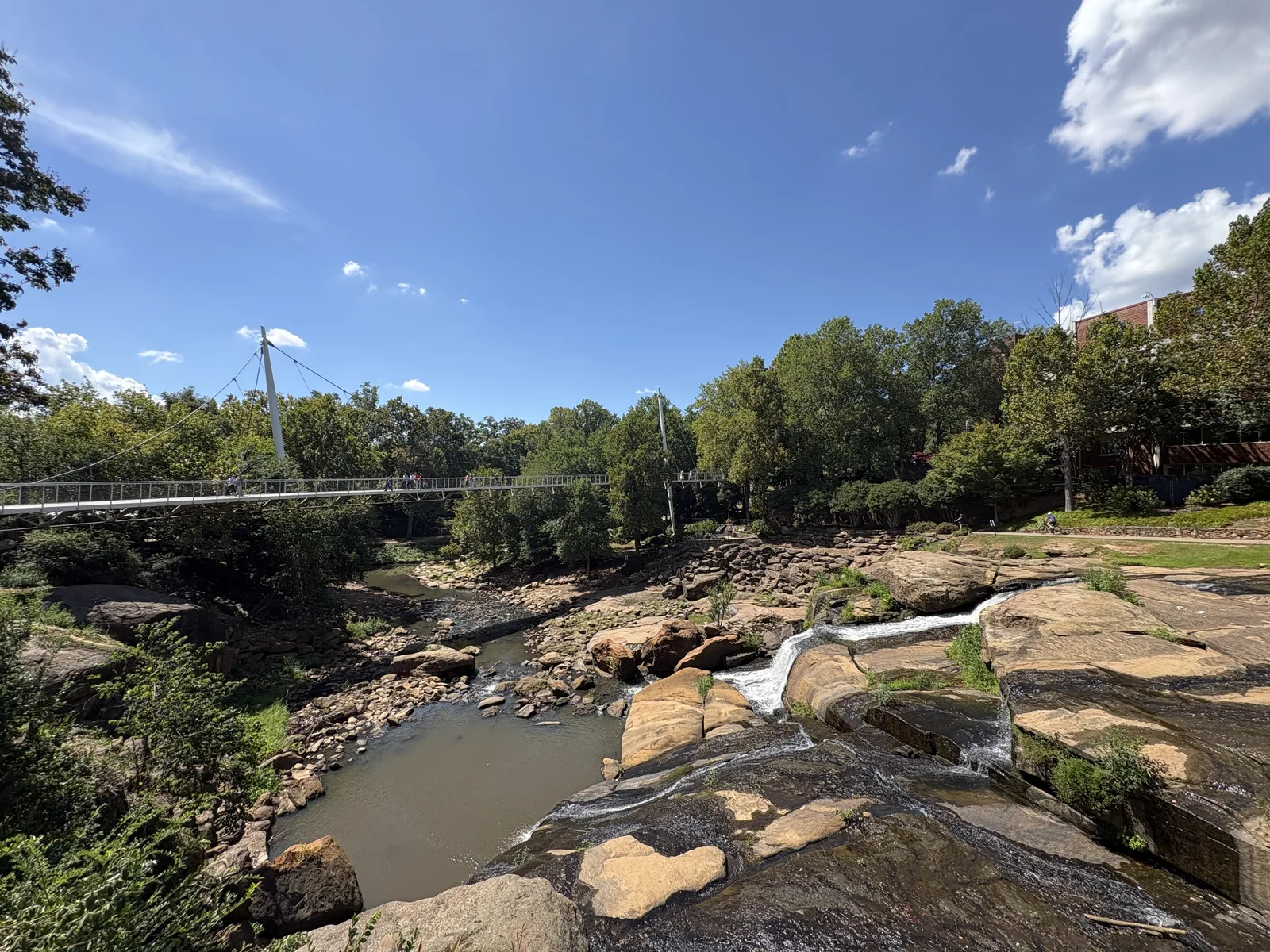
For decades the best thing Greenville had was sitting under a highway bridge. The falls on the Reedy were still there the whole time, just covered over, out of sight, and worked around. Everything built on top of them underperformed, because the reason this place was worth anything had been paved over.
Then somebody tore the bridge out. That is Falls Park now, and downtown followed it.
We see the same story in houses every week. The foundation is the part nobody looks at, and it is the part that decides what everything above it can do. Uncover it, fix it properly, and the rest of the house finally works the way it was meant to.
With a booming city comes a lot of rotation in the housing stock. Plenty of new homes are going up, and just as many homes from years past are changing hands and getting remodeled. Those homes carry a higher likelihood of structural and foundation problems.
Time alone can be the reason. Somewhere along the way a termite treatment got missed and now there is termite damage. A leak went unnoticed and there is water damage. Moisture had years to work in the crawlspace. Framing that was over-spanned to begin with started to dip under load. A remodel changed the loads but not the framing, so things are dipping and cracking. Water has held where it should not, or soft clay has led to sinking. All of these things happen to homes, and every one of them can be corrected.
We got our start in Greenville and we've seen it all. We've fixed mill homes in Berea, Welcome, Judson, Woodside, Monaghan, Poe Mill, and Dunean. We've fixed historic homes in Hampton-Pinckney and older homes in Nicholtown. We've worked the spots that were the place to be back then and still are today, like Alta Vista, Augusta Road, North Main, and Cleveland Forest. We've worked the ones that came after them, like Chanticleer, Gower Estates, Parkins Mill, Sherwood Forest, and Botany Woods. And the ones after those, like Foxcroft, Thornblade, Kilgore Plantation, and Spaulding Farm. We've also fixed houses in all the places that were wonderful to call home but never got a cool name attached to them. We love a ranch house. We've re-framed so many we could about do it in our sleep.

Why Greenville Homes Move
The Upstate sits on Piedmont residual soil, mostly Cecil, Madison, and Pacolet clays that weathered in place from the granite and gneiss underneath. Left undisturbed it is competent ground. It holds a footing fine. Two things change that.
Water
These clays shrink and swell with moisture. Poor grading, a downspout discharging right at the footing, or a crawlspace that stays wet year round will move a foundation that would otherwise sit still for a century.
Fill
Almost every subdivision built here since the 1970s sits on a graded pad, cut on the uphill side and filled on the downhill side. If that fill was not placed and compacted correctly, it consolidates under load. That takes five to fifteen years to show up, which is why houses that were perfect at closing start cracking a decade later.
Neither one is unusual for this area. Neither one means a house is unsafe. Both are fixable.
What We See in Greenville, By Era
A brick pier house in the Monaghan village has almost nothing structurally in common with a slab house out toward Verdae. Diagnosing them the same way, or selling them the same repair, is how homeowners end up paying for work that does not fix anything. Here is what each vintage actually does.
Not listed? Most homes here still fall into one of these five. Open whichever era matches roughly when your house was built.
Mill Villages and Early Neighborhoods 1890 to 1930
Poe Mill, Monaghan, Brandon, Woodside, Judson, Dunean, West Greenville, Sans Souci
Greenville annexed most of its villages, so a mill house here usually sits inside the city with city utilities and a century of code changes layered over company-built framing.
What we usually find
The mill villages were built fast and cheap for mill workers, sold off to those workers in the 1950s, then modified by owners for seventy years with no coordination. The other early neighborhoods on this list were not company built, but they went up the same way and they behave the same way. Structurally they are true pier and beam: isolated brick piers, often with little or no real footing under them, no continuous perimeter wall, and floor framing that was undersized when it was new. We usually find piers that have settled or rotated, joists sistered and shimmed from decades of DIY correction, added rooms and enclosed porches sitting on even shallower foundations than the original house, and bare dirt crawlspaces with no vapor barrier. Termite, powderpost beetle, and rot damage are common in this vintage.
What actually fixes it
Proper footings under new piers, or helical piles where the soil calls for it. Correct girder support. Encapsulation to stop the moisture cycle that caused half the movement in the first place. These houses are almost always worth repairing. The framing is old growth lumber and the bones are better than the piers holding them up.
Pre-War In-Town 1900 to 1940
Alta Vista, Augusta Road, Augusta Circle, North Main, Cleveland Forest, Overbrook, Hampton-Pinckney, Nicholtown
The Augusta Road and North Main houses are the most renovated stock in the city. Most have been through two or three rounds, and each round added load the original footings never anticipated.
What we usually find
Deep crawlspaces, brick or stone perimeter walls, shallow footings by modern standards, and often a partial basement that was dug later. Many of these homes have been renovated two or three times, and each renovation added load the original foundation was never sized for. A second floor addition, a kitchen bump-out, a heavy tile floor. What shows up is differential settlement where an addition meets the original structure, bowing or leaning basement and crawlspace walls, and moisture coming through unsealed masonry.
What actually fixes it
Underpinning at the settled section, carbon fiber or steel reinforcement on walls that have moved laterally, and drainage correction. These are high value homes and the repair has to be done in a way that survives scrutiny at resale.
Postwar Ranches 1946 to 1970
Botany Woods, Chanticleer, Gower Estates, Parkins Mill, Sherwood Forest, Del Norte, Green Valley, Pleasant Valley
Greenville ranches sit on the first generation of cut-and-fill grading in the county, which is why so many of them need work at exactly one corner and nowhere else.
What we usually find
Block perimeter crawlspaces on continuous footings, some slab on grade, and the first generation of cut-and-fill lot grading in the Upstate. The construction itself is generally sound. The issue is where the house sits on the lot. Settlement concentrates on the fill side, garage slabs and carports drop away from the structure, and the crawlspace carries sixty years of accumulated moisture damage.
What actually fixes it
Targeted underpinning on the settled quadrant, not the whole perimeter. Most of these houses need work at one corner, not all four. Anyone quoting a full perimeter pier system on a 1960s ranch should be asked to justify it.
Suburban Overflow 1980 to 2005
Foxcroft, Spaulding Farm, Maplestead Farms
In a Simpsonville or Five Forks subdivision? See our Simpsonville page
Very little of this vintage is inside the city limits. Most of the 1980s and 90s buildout happened in Simpsonville, Mauldin and Five Forks instead.
What we usually find
Block perimeter crawlspaces with interior CMU pier lines carrying a built-up girder, moving to slab on grade toward the end of the era. Volume built on graded pads. The signature problem is interior girder line settlement, meaning floors that slope toward the middle of the house instead of toward the outside walls, because the interior pad footings were undersized and often placed on fill. Add vented crawlspaces with torn or missing vapor barrier, and a downhill perimeter wall taking lateral load it was not designed for.
What actually fixes it
Interior pier and girder support, wall reinforcement where the block has moved, and encapsulation. This vintage is frequently all three in the same visit.
Modern Slab Construction 2000 to today
Verdae, Hollingsworth Park, Montebello, Hartness
Five Forks and Simpsonville have their own page. See our Simpsonville page
Verdae and Hollingsworth Park are the largest in-city examples, built on a mass-graded pad, which makes the flatwork behave exactly the way you would expect it to.
What we usually find
Monolithic slab on a mass graded pad. The house slab itself is a stiff plate and usually rides settlement as a unit. The flatwork does not. What we get called for is driveways, garage aprons, front walks, stoops, patios, and porch slabs settling and separating from the house, almost always on the fill side of the lot. Voids under slabs, trip hazards, and water running back toward the foundation.
What actually fixes it
Polyurethane foam lifting. It is fast, it cures in minutes, it does not add meaningful weight to soil that is already consolidating, and the drive is usable the same day. Structural underpinning is rarely warranted on this vintage. If someone proposes it for a settled driveway, get a second opinion.
Noticing Any of These in Your Greenville Home?
Click any sign to see what causes it and how we fix it. Straight answers, no scare tactics.
Foundation, Crawlspace & Concrete Repair in Greenville
Every one of these is work we do in Greenville. Click a service to see how it works and when your home actually needs it.
Foundation crack repair, settlement stabilization, and pier systems that permanently stop foundation movement.
Foundation solutions →Sagging floor repair, joist and beam replacement, termite and rot damage, and wall separation fixes.
How we re-frame a house →Crawlspace encapsulation, moisture control, and support jack installation under your floors.
Inside a crawlspace repair →Open up your space, give your home a whole new feel with load bearing wall removal.
Opening up a wall safely →Polyjacking lifts sunken driveways, sidewalks, patios, and garage slabs, usually in a single day.
Learn about concrete leveling →Engineered helical piers, push piers, and tiebacks for residential and commercial foundations.
Compare pier systems →How We Fix Greenville Homes
Ordered by what Greenville homes actually need. We do all of it.
What You Should Expect From Us
We'll tell you if you don't need us.
Plenty of cracks are cosmetic or seasonal, and we would rather say so.
We'll show you the cause.
If grading or drainage is driving it, piers alone will not hold.
We'll scope it to the problem.
Most houses need work in one area. A whole-perimeter quote should come with a reason.
What Greenville Homeowners Are Saying
Questions We Get From Greenville Homeowners
How much does foundation and structural repair cost in Greenville?
It depends entirely on what's actually wrong, which is why we don't quote a number over the phone. Your estimate is free, accurate, and the number you'll actually pay.
Do you do crawlspace repair in Greenville?
Yes, and it is most of what we do. Crawlspace repair covers encapsulation, moisture control, and structural repair to the framing above it. Sagging or bouncy floors are almost always a crawlspace job rather than a foundation one.
Do you offer free inspections in Greenville?
Yes, always. No cost, no obligation.
Does Greenville's clay soil mean my foundation could shift again after repair?
A proper repair addresses the cause of the movement, not just the symptom. That is the difference between a permanent fix and a patch that comes back.
My driveway has dropped away from the garage. Does that mean my foundation is failing?
Usually not. On newer slab-built homes around Five Forks and the Harrison Bridge corridor, the house slab and the flatwork sit on different ground and settle independently. A settled driveway is almost always a concrete lifting job, not a foundation job. We will tell you which one you have before we quote anything.
The Shining Star of the Upstate
Greenville got its start from a land deal on the Reedy River. Around 1770 an Indian trader named Richard Pearis, by way of Virginia, received roughly 100,000 acres from the Cherokee, the land that is downtown Greenville today. He started a family with a Cherokee woman, built a plantation he called the Great Plains, and put a gristmill on the river to serve it. That mill was the first water-powered business here, and a great many followed.
He lost all of it. Pearis sided with the Loyalists, the Patriots burned his plantation and jailed him in Charleston, and he never got the land back. His name stayed anyway, worn down over the years into Paris Mountain.
Lemuel Alston arrived in 1788, bought 400 acres including part of Pearis's old plantation, and laid out a village he called Pleasantburg. It never took. The lots sold slowly and nobody would use the name. The place was called Greenville by 1821 and was incorporated as a village ten years after that. Where the name came from is genuinely lost. Possibly Nathanael Greene, possibly an early settler named Isaac Green, and plenty of people here will tell you it was simply how green the place was.
Greenville becomes a real town under Vardry McBee, who bought Alston's land in 1815 and then spent his life giving pieces of it away. Land for churches, land for schools, land for cotton mills. He gave the ground that brought Furman here in 1851, and he pushed for the railroad that reached town two years later. Before any of that, Greenville was not an industrial place at all. It was a summer resort, where lowcountry families came to get out of the heat.
The mills arrived in the 1870s, starting with Camperdown, and the villages around them gave their names to half the neighborhoods on this page. When textiles went, the shift to something else began under Max Heller, an immigrant and former textile worker who became mayor in 1971 and started the work of bringing downtown back. Afterward, as chairman of the state Development Board, he helped bring Michelin to the Upstate and opened the door for the international companies like BMW that followed.
Then Knox White partnered with the Garden Club to do the thing nobody else would. Tear out a highway bridge, uncover the falls, and build Falls Park.

Serving the Upstate of South Carolina
Foundation and crawl space repair across twelve counties of the Upstate and beyond. Hover a city to see it on the map. Not listed? Call and ask. If we don't cover you, we'll tell you straight.
We work throughout Greenville County and the surrounding area: Greenville, Greer, Simpsonville, Mauldin, Fountain Inn, Travelers Rest, Taylors, Five Forks, Berea, Piedmont, Powdersville, Easley.
Get Your Free Estimate in Greenville
No pressure, no obligation. We'll come look, tell you straight, and give you a number you can trust.